I’ve never boarded the official supporters’ coach. I just can’t do it. I cannot open that door. And to be absolutely clear, this isn’t a dig at fellow Vale fans – far from it – and it’s certainly not about the coaches themselves. I actually like a good coach trip; I’ve spent enough lost hours on National Express to prove it. It’s simply the experience, or the version of it I imagine, that doesn’t quite fit me.
There’s a kind of pre‑planned tidiness to it all that I struggle with. Too structured. Too neatly packaged. Those coaches run on an itinerary: depart 8:15, break at Gloucester Services, arrive at 2pm, leave at 5:15. Someone at the front counting heads, making sure everyone’s on. Very communal, very sociable, very shared – brilliant for lots of people. Just not for me. I crave a bit of looseness, a little unpredictability. The sense that anything could happen. The whole day left completely in the hands of fate.
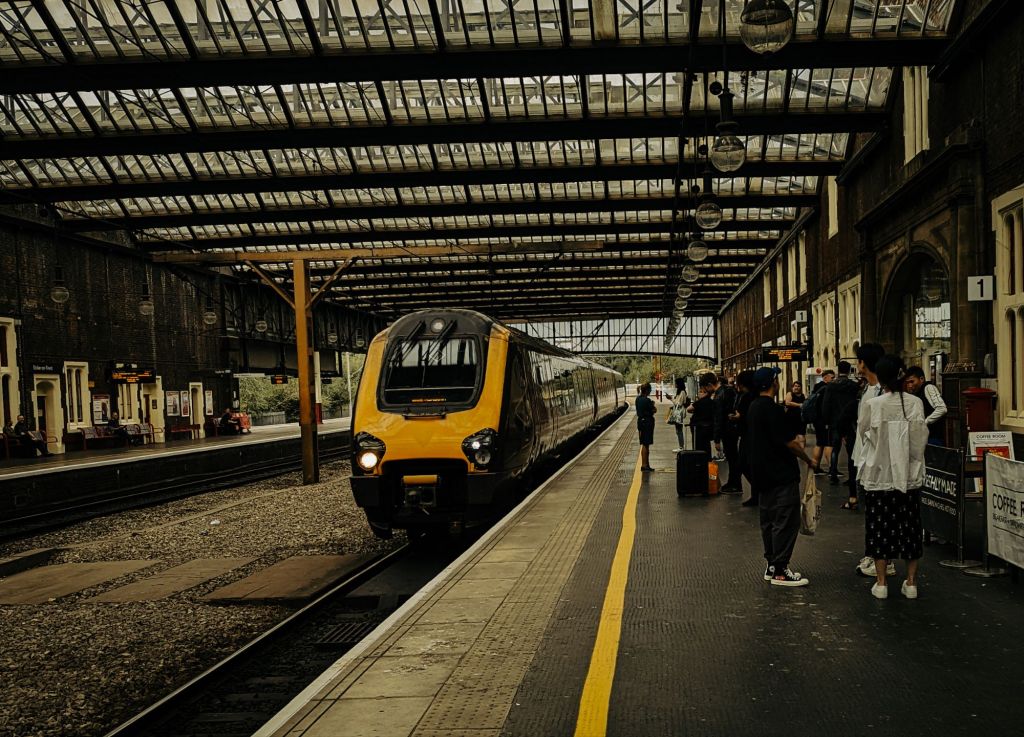
Which is why I always go by train.
Give me a train – any train – a wheezing four‑carriage thing heading north, south, east or west through the slow morning. The destination hardly matters. What matters is that the railway gods have taken your offering and will now play with you as they see fit. Mystery and adventure exist between cancellations, delays, and missed connections. Strangers drift in and out like passing signals. You sit at a window seat and watch England slide past like a daydream: grey skies, green fields, lonely horses, warehouses that have seen better centuries.
Travelling by train to a football match carries its own kind of existentialism. You’re moving and not moving at the same time, suspended between stations, neither here nor there but somewhere entirely your own. Life is paused and hurtling forward all at once. You exist in the gap between realities: the one you left and the one with a stadium, floodlights and noise. The carriage sways, your mind wanders, and suddenly life feels like something that might just make sense if you stare at it long enough through a rain‑streaked window.
Watching the familiar station names drift by: Congleton, Macclesfield, Prestbury, Poynton, Stockport, Levenshulme on the way to Manchester Piccadilly. Stafford, Wolverhampton, Birmingham New Street, Northampton, Milton Keynes Central, Bletchley, Leighton Buzzard, Watford Junction on the way to London Euston.
And then those golden, life‑affirming moments – the ones you only get on the trains – like standing on the platform at Nuneaton, wondering how you ever ended up there, knowing full well you shouldn’t be there, and trying to work out how you’re going to escape from there. Watching the departures board, hoping and praying that a route to somewhere you understand reveals itself, then turning around to see four or five other people doing exactly the same – wearing the same expression of confusion and despair – and realising that you’re never alone in this world.
Or being wedged into that grim limbo between carriages – the bit that smells of stale air, long-abandoned sandwiches and urine – crammed shoulder-to-shoulder with twelve other unfortunates. Forty eternal minutes by the toilet because the train is full. The floor trembling under you like the engine itself is having second thoughts. Forced to endure two Wolves fans locked in a loop, banging on about West Brom, over and over, that black country drawl vibrating somewhere behind your eyes. And you, knowing that this torment cannot last forever, that it will eventually leave the train, and that your spirit will, once again, be acquainted with liberation and peace.
Or drinking a beer at Crewe station, sitting back and starting the detective work that always fills these in‑between moments – trying to piece together where everyone’s from, where they’re going, what fragment of footballing pilgrimage they’re on. Replica tops and overheard accents drifting past like clues in a slow-moving puzzle; every detail is a thread to pull at.
Or arriving at Liverpool Lime Street, changing for Birkenhead, Tranmere away. The air feels different here – charged – the way stations do when they’re gateways to cities with gravitational pull. The scouse cadence in the announcements, the murmuring crowds, the background hum of a city that knows exactly what it is.
And that little bit of castle at Berkhamsted – you know it, heading towards Euston – just a ruined fragment, really. But you glide past it and your imagination starts to run riot – you’re picturing banners, and horses, and the muddy churn of a medieval morning; an unlucky peasant losing their head for stealing turnips, others casually booting it around like a football. Maybe that’s where it all started – the beautiful game – a displaced head, tunics-for-goalposts, no VAR, robust guidelines on what constitutes handball, the losing team publicly flogged to within an inch of their lives in the town square. When football was better.
And then there’s the people; boarding at each station – drifting in like actors onto the stage.
The football lads; loud, buoyant, lager‑scented. Stone Island, Adidas Sambas, identical haircuts. Drinking since 5am – not out of necessity, but as an opening gambit in their ritual with the footballing gods. You can’t fault the commitment. They stumble aboard like a travelling circus, and suddenly the carriage is a pub without walls or boundaries. Posing for social media pics, get the badge in, 48 cans of continental piss stacked on the table, cheeky lines in the toilet. Loving life, making memories and not giving a single fuck.
The drifter from the West Country. He isn’t supposed to be on this service. He knows it. You know it. The universe knows it. But he’s here now, like a wandering prophet of wrong platforms, pastry crumbs in his beard, loyal to the cargo-shorts-with-socks-and-sandals combination despite it being the middle of winter, ready to tell you about his ex-wife’s new lover, and the time he once met snooker legend Dennis Taylor in a Greggs in Ilfracombe. His conversations move in long, wandering circuits untroubled by logic, like someone who’s never met a straight line in his life. And then suddenly he’s gone. And you’ll never ever see him again in your life.
And the person none of us can ever avoid. The Chatty Bore. Every train has one. And it’s always a bloke. Always. The universe appoints them. No train is complete without them. They find you like water finds the lowest point. You try to read, to listen to music, to stare wistfully out of the window – but they are relentless. They want to talk about signalling failures, conspiracies, Golden Wonder crisps, their cousin who had a trial at Crewe Alex in 1997, about anything and everything. On and on and on. And then they log it all in a battered notebook for reasons only they will understand. It’s all a bit creepy, a little bit weird, and look – maybe these people are just trying to make sense of the world around them like the rest of us are. Who knows?
And then, between all the chaos, it happens: that little quiet moment. You look out the window and feel utterly, vividly alive in the act of just going somewhere.
And the beauty of all of this is simple:
You don’t ever know what’s coming next. You don’t know what catastrophe awaits at Bristol Temple Meads or who’ll board at Taunton, or whether the buffet trolley will have anything left beyond a chunky Kit Kat with PTSD. That’s the allure. That’s the jazz of it. Not the destination. Not the match. Not even the promise of three points.
Just the going.
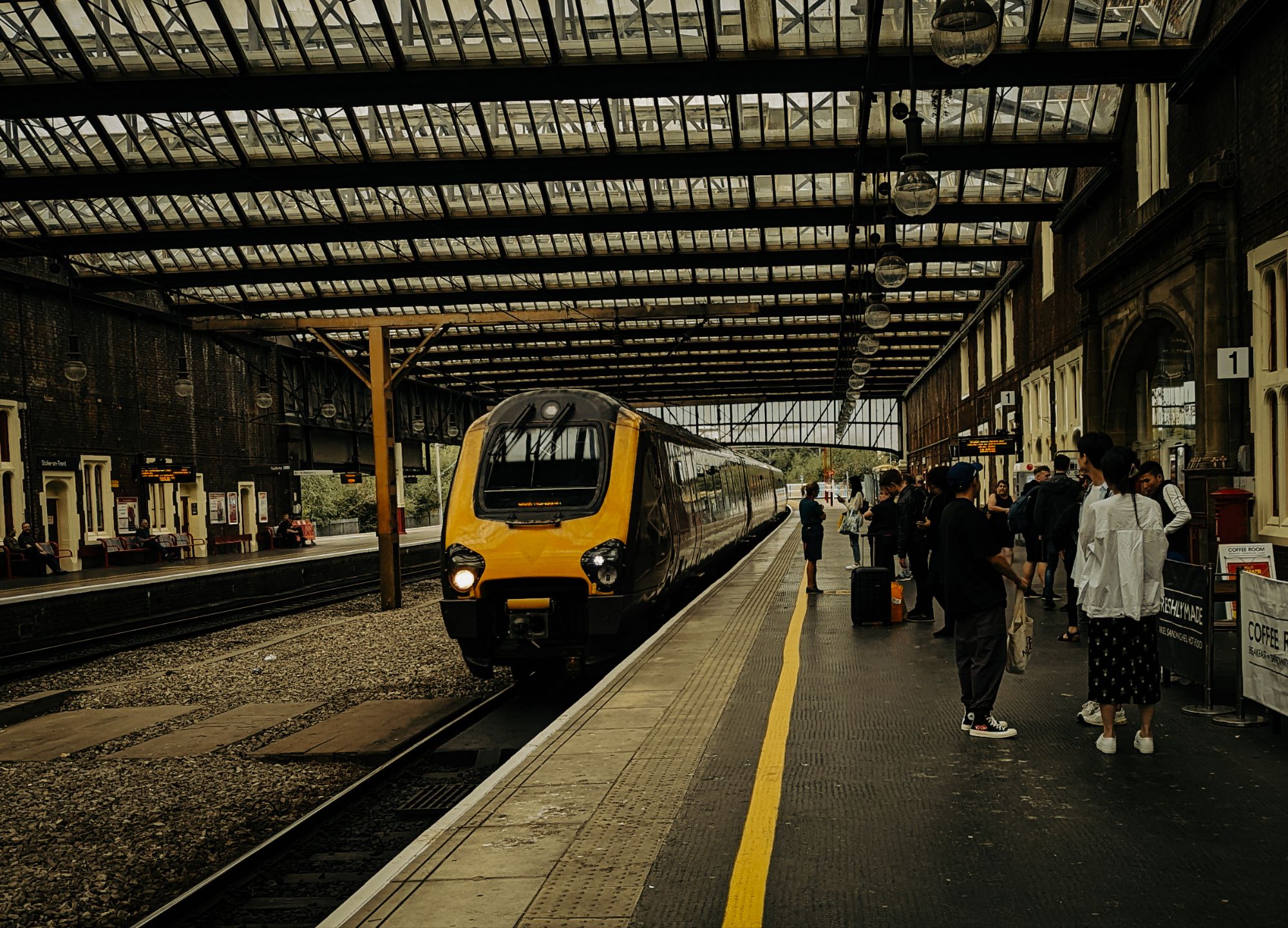
And when the train finally drags itself into the station of whatever far-flung footballing outpost you’re invading, you step out onto the platform, the air hits you and your brain suddenly begins to join the dots from the last time you were here, a few seasons ago. Crossing the bridge to find the Way Out, that little pub 5 minutes around the corner. It all comes back. And you spill out of the station with all the others, a small migrating tribe of hope and delusion, bound together by a regional accent and a willingness to be emotionally devastated by 4:55pm.
But it doesn’t end there.
Because the return journey is another universe entirely. It’s not merely the morning pilgrimage played in reverse; no, it’s its own bizarre world, its own wild chapter, its own strange little saga. An evening train back to Stoke-on-Trent from anywhere in the UK on a Saturday becomes a floating microcosm of England at dusk.
And it is wonderful.
A brand new cast of characters join the show.
A pack of young ones pile on – all hair products, oversized coats, entire economies’ worth of perfume clouding around them. Their night is just beginning. You can hear it in the restless buzz of their laughter, their enthusiasm for everything and nothing, in the fizz of expectation as they pre-drink from cans overloaded with sugar, caffeine and alcohol. They’re heading for the bright lights – whichever ones burn longest, wherever the music is loud enough to drown out the week they’re trying to forget and the Monday morning they are already dreading.
Then come the sleepers. The ones who opened their eyes at 6am and cracked open their first can at 6:03. The ones who know the inside of every pub between Carlisle and Cornwall. Replica shirts stretched tight across heroic bellies, last season’s sponsor peeling at the edges. A Lidl carrier bag swinging at shin height, three warm tins of slosh rattling inside. They slump, snore like tectonic plates shifting, like men who have fought the day and been absolutely flattened by it. They sleep with mouths open, heads lolling, necks at biologically impossible angles – and yet somehow, they are the most peaceful beings on the train.
The closer you get to Birmingham, the fuller the train becomes – as if the entire West Midlands is magnetised by the scent of lateness and poor decisions. Shoppers. Students. Clubbers. Theatre-goers. Lost souls. Lonely hearts. Someone clutching a kebab as if it was something sacred. The carriage fills and fills until personal space becomes a distant memory. Far more people than seats. Sardines in a tin. How did this become the norm? When did we accept it?
The smell becomes a cocktail: sweat, cheap cologne, spilled beer, deodorant from the value aisle, chips, ambition, heartbreak, and dreams. Look around and every face tells a story. A woman texting with tears rolling down her cheeks. A little firm of young Oldham lads chanting tunelessly. A solitary bloke reading a battered paperback like it’s the only thing holding him together. The train rattles and hums, carrying all of them – their highs, their lows, their ordinary-yet-extraordinary lives – and me, through the darkening Midlands towards the North.
And here we all are: the ravers still shimmering with last night’s chemicals, the casuals with their studied swagger, the romantics hanging by threads, the loveless drifting like satellites, the battle‑scarred and the buoyant, the lost, the found, the ones numbed by vices and the ones taped together by hope. A rolling census of the overlooked, the overflowing, the overwhelmed and the barely‑holding‑on.
And this is when it hits you:
Train journeys are beautiful.
No filters, no expectations – just people moving through the world together for a few brief stops before scattering again into the night. And as the train curves toward Stoke-on-Trent, that same warm, ironic gratitude rises inside me, the kind that comes with all good journeys.
The outward trip is hope.
The match is the storm.
But the way back – this messy, crowded vessel of wandering souls – is the poem. That’s why it’s beautiful. Life isn’t in the ninety minutes you came for. It’s everything around them: the stories on the rails, the strangers drifting to sleep, the faint smell of dreams, the desperation that keeps people moving.
This is the journey home.
Chaotic, human, imperfect – It’s what makes football, travel, and life on the trains utterly, magnificently worth it.
And it all begins here: in the clatter of wheels, in the tracks between us.


 tales from the paddock
Leave a comment