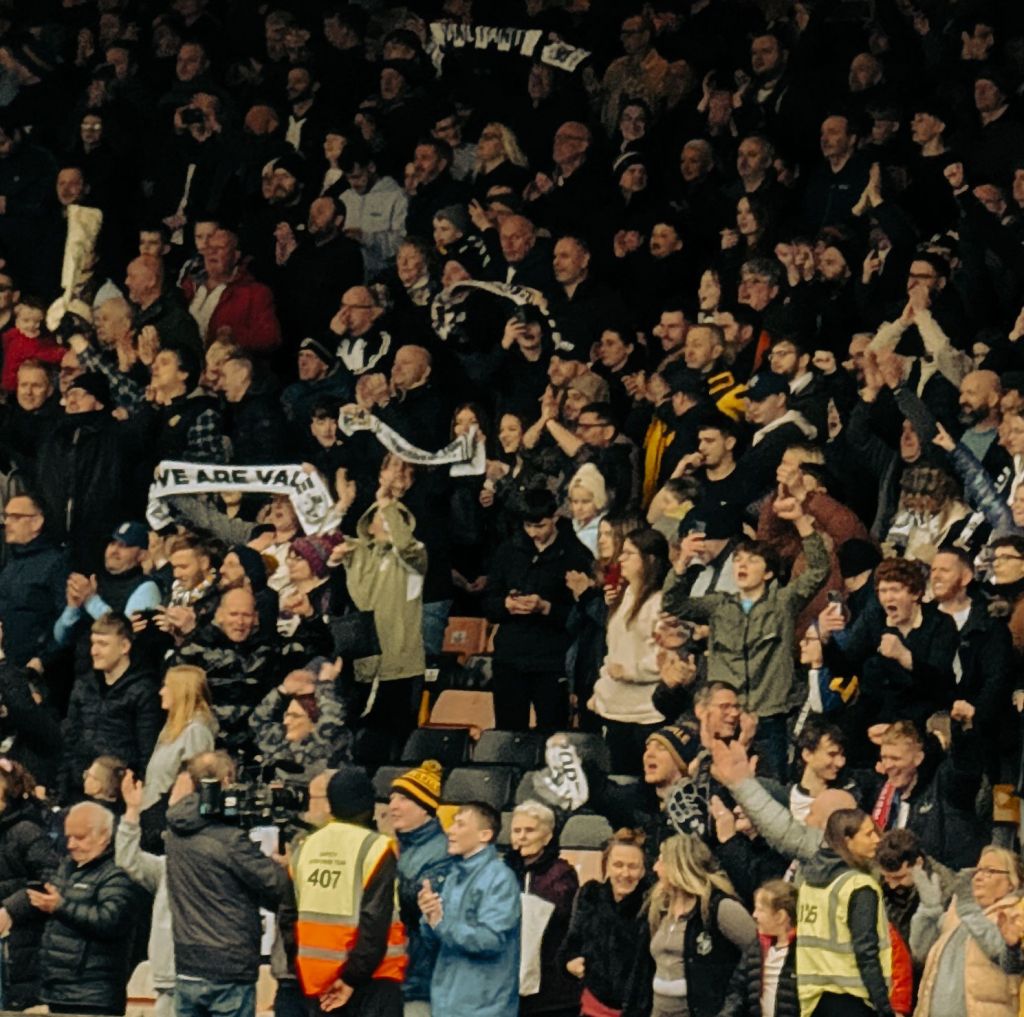
Durkheim’s concept of collective effervescence highlights the powerful connection between emotional contagion and football. We have all witnessed it, we have all been part of it, whether we realise it or not. The shared joy, despair, anticipation and belief that ripple through a crowd demonstrate exactly how emotions can spread and intensify within a collective, giving us an experience that goes far beyond a game of football.
We’re at home to Crewe on Saturday. Our season has yet to find any kind of rhythm; theirs has sprung into life from the outset. Add in the rivalry and the natural tension that comes with it, and Vale Park is going to be highly-charged. We’re only two games in and this already feels massive.
What you are about to read is not about the manager and players. That will come after the match. This is about us, and the dynamics that dictate the atmosphere in Vale Park.
Fetch a spade and we’ll dig in.
Emile Durkheim (1858-1917) A pioneering French sociologist who sought to understand how societies create meaning, solidarity, and social cohesion.
Collective Effervescence Durkheim’s term for the heightened sense of energy, unity, and belonging that emerges when people gather around a shared emotion, purpose, or moment.
Emotional Contagion The process by which emotions spread through a group, causing individuals to unconsciously mirror and share the feelings of those around them.
Football Twenty-two players chasing a ball around a field. Also, a ninety-minute ritual through which strangers become a crowd, a crowd becomes a community, and a community briefly becomes something greater than itself.
Port Vale FC A football club from Burslem, Stoke-on-Trent. Responsible for some of the happiest and most emotionally exhausting days of our lives since 1876.
Émile Durkheim’s concept of collective effervescence describes the surge of emotional energy that emerges when people gather around a shared purpose, identity, or ritual. Durkheim was talking about religion, but if he’d ever stood in a packed Paddock after a last-minute winner he’d probably have started taking notes. In these moments, individuals cease to feel like isolated spectators and experience a powerful sense of unity, belonging, and shared meaning.
Without doubt football stadiums provide one of the clearest modern examples of this process. Through our chants, songs, applause, and club symbols, supporters create an emotional atmosphere that strengthens both group identity and commitment to the values they believe their club represents.
Importantly, collective effervescence is not always positive. The same forces that generate joy and solidarity can also amplify frustration and dissent. When a team performs poorly, supporters do not react in isolation. Emotions become collective, gaining strength as fans recognise that others feel the same way.
So imagine a team, purely hypothetically of course, conceding a soft goal, early doors, after a few disappointing performances. I know, it’s a ridiculous thought experiment. Bear with me. One supporter may grumble quietly, but when boos begin to ripple around the stadium, individual frustration can rapidly become collective dissent. Durkheim argued that collective emotions carry greater force than individual ones. What begins as a personal reaction can quickly develop into a shared judgement.
Football grounds provide ideal conditions for this process: physical proximity, a common focus of attention, strong group identity, and repeated rituals. Sociologists refer to the spread of such feelings as emotional contagion, which typically follows a simple pattern:
- A triggering event occurs.
- Frustration becomes audible.
- Others recognise the feeling.
- The dissent gains legitimacy.
- The reaction snowballs.
From a Durkheimian perspective, crowd dissent is more than mere dissatisfaction. It functions as a form of collective moral judgement. Supporters are not only reacting to results but to perceived breaches of the values they believe the club should embody, such as effort, commitment, and honesty. Booing, protest chants, or calls for change become rituals through which fans reaffirm their shared identity and express what they believe their club ought to be.
So, now we’ve got that straight, let’s look ahead to Saturday lunchtime and Crewe’s visit to Vale Park. What happens if Crewe score early? Three minutes gone, and a soft goal conceded. What happens then? What happens to us, the fans? What happens to the players? Is there any way to avoid the toxicity that will absolutely engulf the ground?
More importantly, can we influence what happens next?
I think Durkheim would probably argue that we can.
And with that in mind, we could, if we wanted, make Saturday a small sociological experiment. Nothing too fancy, no lab coats, no clipboards, no subliminal messaging. Just fifteen thousand years of evolutionary psychology, a football match, and a collective decision not to lose our heads after three minutes.
The easy assumption is that the crowd simply reacts to events. Crewe take the lead, anger and frustration follows. Cause and effect. That’s natural law. But collective effervescence suggests something more complicated. The crowd is not merely a collection of individuals responding independently to circumstances. It becomes its own social fact, a force greater than the sum of its parts. Once gathered together, our emotions cease to belong entirely to us. They become shared, amplified and reflected back.
Within moments, thousands of people are participating in a mood which none of them consciously created. The anxiety becomes contagious. The nervousness migrates from stand to stand like an electrical current. And before long, the players will feel it too. It makes its way onto the pitch. The players, like supporters, are not immune to collective emotion. Sports psychologists have long recognised that confidence is fragile and highly influenced by environmental cues. It turns out footballers are human beings. If 7,000 people collectively sound like they’re expecting disaster, players tend to notice.
We sense despondency in the players; the players sense despondency in us. Each feeds the other in a self-perpetuating cycle. Emotional contagion is not an abstract theory here. It is visible every Saturday afternoon. We watch it happen in real time. But collective effervescence cuts both ways. Because if negativity can spread, so can belief. Players hear anxiety. They feel tension. They recognise frustration. Equally, they recognise support.
Now, let’s imagine the same scenario differently. Three minutes gone. Crewe score. It’s sloppy. That horrible split-second of silence before the trainspotters start celebrating as though they’ve personally solved cold fusion. Those familiar feelings begin to surface. The groan catches in the throat. The frustration starts to rise.
And then someone starts singing. For Vale. The Paddock picks it up. The Hamil joins in. Even the Lorne Street responds. The message around Vale Park is simple: we’re all behind you. The players, instead of feeling judged, feel carried. Confidence, like anxiety, is contagious. Maybe we underestimate this as supporters. We tend to think our job is simple. Turn up, drink beer and eat pies, complain about the ref, offer tactical advice from 50 yards away, and pass judgement on what unfolds before us. And, of course, there is absolutely nothing wrong with that.
But Durkheim would remind us that we are participants in the ritual itself. The match is not performed solely by the twenty-two players on the pitch. It is co-produced by everyone inside Vale Park. For ninety minutes, Vale Park becomes something tribal. Thousands of strangers united by colours, songs, memories and loyalties. We laugh together, suffer together and occasionally transcend ourselves together. In those moments, the crowd takes on a life of its own.
The question where collective emotion is concerned is what we choose to do with it. Vale Park can be many things. It can be anxious. It can be impatient. It can become a place where every misplaced pass is greeted with groans, every mistake magnified, every setback treated as confirmation of our worst fears. When that happens, the atmosphere feeds on itself. Nervousness becomes tension. Tension becomes frustration. Frustration becomes toxicity. We have all experienced this.
But it can also be extraordinary.
It can be a place where our belief survives setbacks. Where thousands of us drag Vale forward through sheer force of will. Where a setback becomes a rallying cry rather than a reason to turn on our own. We’ve all seen days when Vale Park felt less like a football ground and more like a living thing, carrying players over the line, a sheer bloody-minded refusal to accept defeat.
Both versions of Vale Park are real. Both are within our reach. And neither is created by Jon Brady, or the players, or the ref, or the opposition, or the league table. They’re created exclusively by us. It’s in everything we do at Vale Park – every song, every chant, every time we boo, every time we cheer, every moment of vitriol, every act of encouragement. Together, we shape the emotional environment in which the game is played.
So if thousands of Vale fans acting together can unintentionally create a toxic atmosphere, then surely those same thousands can consciously create something better.
Of course, there is another aspect to this. There is nothing more satisfying as an away fan than when you’re comfortably winning and the home fans have completely lost their heads. Raging. Seething. Fuming. It is a beautiful sight. Adults descending into meltdown right in front of your eyes. It isn’t just the icing on the cake, it’s the cherry on top as well. If it isn’t going our way let’s not give Crewe the added pleasure of watching us unravel. Of course it hurts, but we can save it for afterwards. We can save it for the pub. We can save it for the journey home.
Saturday will probably tell us a lot about Jon Brady and the players. It might also tell us something about ourselves. Because the atmosphere inside Vale Park is not something we inherit, it is something we choose.
And if Vale Park is a reflection of who we are, then on Saturday we define ourselves. Durkheim would probably have had a fancy French phrase for it. Most of us would call it getting behind the Vale.

 tales from the paddock
Leave a comment