There are many ways to spend a weekend.
There are people who spend theirs away, and I mean properly away, like boutique hotels in the Cotswolds, coastal walks in Cornwall, spa breaks with complimentary robes and cucumber water. That kind of thing. The middle classes disappear to converted barns in the Yorkshire Dales, where they eat locally sourced lamb, admire exposed beams, and fret endlessly about social status and money. They return home with artisan sourdough, a fifty quid bottle of extra virgin olive oil, and too many photos of heavily filtered sunsets.
I have a colleague at work who escapes to the North Wales coast with her husband virtually every weekend. Honestly, the moment they’ve finished on a Friday afternoon, that’s it, they’re off. Llandudno, Colwyn Bay, Abergele, Rhyl, Prestatyn. The geography of my 1970s childhood summers.
They’ve got one of those camper van things, not the hip Volkswagen sort you always spot stranded on the hard shoulder with smoke billowing out of the engine, no, one of those sensible, gloriously unfashionable ones favoured by boring, middle-aged people who have long since stopped caring about what others think. They walk the dog along a windswept beach, eat chips, stare at the sea, shout at seagulls, visit a castle, then spend the evening in a welcoming pub five minutes from wherever they’re stopping. She likes a white wine, he has a pint. Ambitions are simple and perfect: a bit of fresh air, a paddle in the sea, a few well-earned drinks. A temporary escape from the daily grind. By Sunday evening they are content, rested, and mentally prepared for Monday.
If it wasn’t for Vale, I suspect my weekends would definitely look something like that.
But we’re not like that, are we? Football fans belong to a different tribe altogether. Our aways are different. Presented with two precious days away from work and responsibility, we voluntarily embark on a seven-hour round trip to an industrial estate on the outskirts of nowhere, via motorways or the National Rail Network, and subject ourselves to traffic jams, delays, cancellations and ninety minutes of emotional turbulence. It borders on self-harm. And where the spa seekers return home refreshed, and the camper van people return home relaxed, we return home battered.
The modern world is obsessed with wellbeing. Absolutely obsessed with it. We are encouraged to slow down, practice mindfulness, reconnect with nature and find our peace. And obviously there’s nothing wrong with that. We can’t knock it. Yet every Saturday, hundreds of thousands of us voluntarily drag ourselves out of bed, hungover, at a ridiculous hour, to go and watch football.
We travel enormous distances at significant expense to destinations you’ll never see featured in travel brochures. Lower-league football fans know England in a way few others do. Not the England of postcards and tourist campaigns, of Wish You Were Here and Judith Chalmers. Not the England of the Peak District or the Cotswolds or the Lake District, or Cathedrals and historic buildings or those places of beauty that a normal person might look to visit on a weekend. No. We go to the other England.
The England of industrial estates and brutalist new towns. The England of concrete precincts and faded municipal ambition. Of sweeping flyovers and monolithic tower blocks. Of isolation, poverty, addiction and depression. The England of market towns reached by two connecting trains and a replacement bus service. The England of tired, bleak Victorian seaside resorts. The England of pubs serving a cheap and cheerful breakfasts at nine in the morning. The England of social clubs and beer poured into plastic pint pots; chip shops with handwritten signs promising the best Pie and Peas in town; shortcuts through piss-drenched alleyways; a sausage roll and a can of Tyskie from a Nisa Local opposite a boarded up bank.
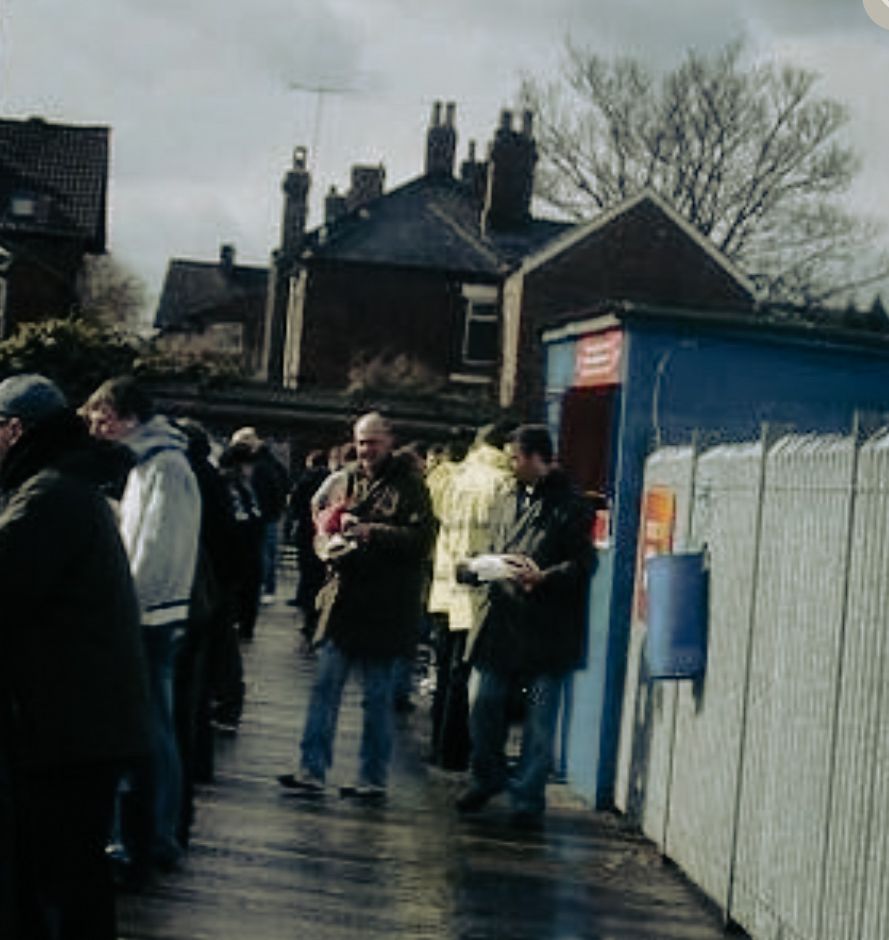
The England of streets that have been overlooked by the modern world, clustered around increasingly forlorn looking (but still wonderful) grounds, where washing lines hang between terraces and floodlights rise unexpectedly above rooftops like medieval church spires. I miss Saltergate. Those away-end toilets were everything. This season, relegation has granted us the freedom to wander through the likes of Newport, Cleethorpes, Fleetwood, Northampton, Gillingham, Crawley, Rochdale, Birkenhead, Colchester, Accrington, Rotherham. Walsall. Now, there is an allure to these places if you are prepared to look for it, it’s not a conventional beauty, but a determined resilience that demands our respect for those who call them home.
Us Vale fans should consider ourselves fortunate. Imagine if our away-days calendar consisted solely of the familiar post-industrial giants and sprawling cities: London, Birmingham, Manchester, Liverpool, Newcastle, Leeds and the rest. Efficient, prosperous, endlessly regenerated and, for the travelling football pilgrim, wholly predictable. Surely nobody wants that? Give us the weathered seafronts, the forgotten high streets, the character, the soul and the heartbeat of the hinterland towns every time.
And the accents. Those glorious, bewildering English and Welsh accents. Within the space of three away fixtures you can travel from the unjustified self-belief of Yorkshire to the sing-song lilt of South Wales, via a place somewhere in the East Midlands where every sentence appears to end with a question mark.
The faces change too. And the further you travel, the more you realise how regional this country remains. It’s all there in the haircuts, the fashions, the brands of sportswear. Of course, we have the ubiquitous football lad clobber, Stone Island, Burberry checks, CP Company, but beneath that uniformity every town seems to cultivate its own variations. To the untrained eye it all blurs together, but the seasoned campaigners spot them immediately, it’s in those subtle combinations: the length of a trouser, the size of a forehead, the cut of a fringe or the angle of a cap brim that mark people out as unmistakably local. The ‘look’ is as distinctive as the accent.
We have towns where every bloke looks as though he has recently ‘renovated’ his cellar, proper Fred West vibes going on; in others, everyone appears to front a Britpop tribute band, identical “Wellend” haircuts as far as the eye can see. There are places where nobody appears to own a coat, and places where a black puffer jacket is compulsory from August to late April. You get all the way down to Exeter or Plymouth, and well, you start noticing the remarkable concentration of big-eared local lads. It must be a rural thing. Has to be. It’s the same at Shrewsbury. And all of this is actually really comforting; you always know where you are and what you’re dealing with.
Most weekend travellers arrive somewhere hoping to be impressed, we arrive wondering where we’ll park. Holidaymakers spend hundreds of pounds seeking an immersive local experience, we stumble into one by accident. We quickly acquire useful local knowledge: Where to find a Spoons, or a recently renovated Tap Room. Which pubs are home fans only and which welcome away fans; which streets to avoid after dark. We learn whether the locals are friendly, hostile or simply baffled by our existence. We know these things.
Many of us develop strange affections for places we would never otherwise visit. Why on earth would anyone go to Stevenage or Milton Keynes unless they’ve got football business to attend to? A nondescript town becomes memorable because that’s where a last-minute equaliser sparked delirium. A forgotten park becomes sacred because it was walked through on the way to promotion. A dreary railway station gains emotional significance because it was where you missed the last train after a 4-0 FA Cup 3rd round defeat in 2017.
These should, by any rational measure, constitute failed weekends. We spend too much money, endure too much discomfort and dedicate entire days to experiences that often end in disappointment. Yet somehow they become the stories we treasure most. Nobody gathers in pubs years later reminiscing about a particularly refreshing spa treatment in Cumbria or a hotel room in Gloucestershire with a lofty goose-down duvet. People do, however, fondly recall getting soaked at Carlisle, stranded at High Wycombe, shivering on a deserted platform at Bristol Temple Meads gone midnight, or celebrating wildly in some forgotten corner of Northamptonshire after an stoppage-time winner.
Away days have this power. They can transform inconvenience into adventure, utter misery into folklore, the staggeringly ordinary into something transcendental and meaningful. Five hours in a car. Two hours on Platform 3. Horizontal rain. A cold Chicken Balti Pie. One functioning toilet. Defeat. These are our weekend staples. We deal in train tickets, motorway services, Uber receipts, Kwik-Save bags full of piss-can lagers, service-station breakfasts, away ends, last-minute platform changes, wrong turns and grabbed pints. Make no mistake, none of this is for the faint hearted.
We revel in the magnificent chaos of the London Underground, the signal failures, the mysterious “customer incidents“, the Northern line suddenly grinding to a complete holt three stops short of Euston, the frantic madness, the bewildered tourists, the suited financiers, the sullen teenagers, the theatre-goers, the buskers, the dreamers, the end-is-nigh merchants, the whole joy of this organised insanity. We take hold of the gauntlet and wander off with it. Nothing, and I mean nothing, ever fazes us.
We know the geography of Britain through ring roads, retail parks, pubs and Greggs locations. Every away day forms another chapter in a story that never seems to end. There is always another season, another bunch of grounds, another promotion chase, another hopeless false dawn, another relegation. Watch us move: we bustle, hurry, rush, dart, scuttle, weave and scamper around towns and cities in small groups. Shifting from space to space with purpose. We’re easy to spot.
While sensible people head towards relaxation, us lot head towards the outskirts of somewhere grim, surrounded by warehouses, dual carriageways, orphaned shopping trolleys and anonymous chain restaurants. Somewhere beyond a B&Q and a self-storage facility, a football ground awaits us.
We willingly travel hundreds of miles to spend two hours standing in the rain. We return home exhausted, poorer than when we set off and often disappointed. We do this for nine months every year. Nobody could mistake it for a wellness retreat. It’s more Google Maps than guidebooks, more service stations than sightseeing. The rewards are few and rarely rational. Yet week after week we climb back into cars, queue for trains and set off once more, chasing ninety minutes of hope that almost never justifies the journey, but ultimately always demands another.
There is something totally honest about all this, while others may seek escape from ordinary life, we drive headlong into its overlooked corners, and all its nooks and crannies, without flinching. We find meaning in places most people spend their lives trying to avoid. To outsiders, it must appear absurd. It is absurd. Hundreds of miles travelled, service station breakfasts, shed loads spent on warm beer in plastic, a one-nil defeat and a long drive home. It all looks untidy, inconvenient, expensive and miserable.
To us though, it feels like a weekend well spent, and somewhere beyond the ring roads, the retail parks and the industrial estates, we find one of life’s simplest truths: football away days are the most wonderful thing in the whole world.


 tales from the paddock
Leave a comment